
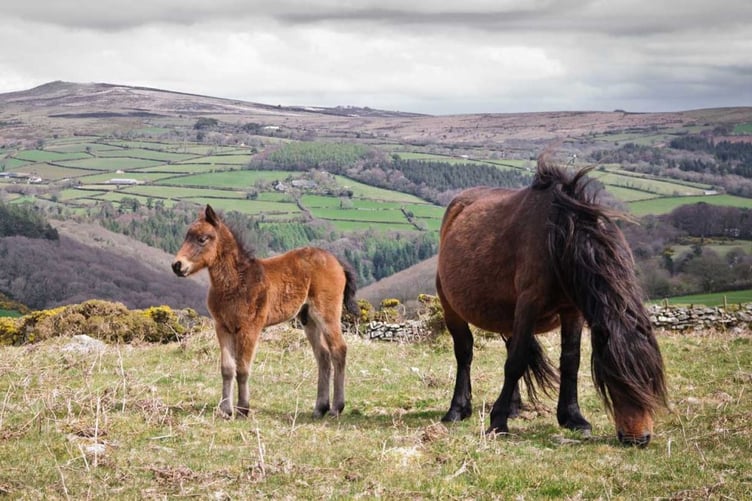
The future of Dartmoor National Park’s wild pony population has been under intense scrutiny in recent weeks, with regulators, conservationists, politicians and campaigners all debating the rights and wrongs of a potential pony cull.
The origins of the debate seem to lie in a view expressed by Natural England (NE - the UK government’s environmental advisory body) that Dartmoor is being over-grazed and, as a result, biodiversity is being harmed.
The proposed solution is that landowners should reduce animal stocking densities by around 75% in order for them to be able to continue to qualify for the Environmental Land Management Scheme (ELMS) and its funding.
The ELMS replaced direct payments as the principal agricultural subsidy to British farmers following Brexit, and it is a major component of farmers’ income.
NE decided that ponies should be included when calculating stock densities, alongside commercially owned cattle and sheep.
Given the cattle and sheep generate income for the farmers, the threat to the semi-feral Dartmoor ponies arises because land owners may be forced to reduce their number to meet the new livestock thresholds for ELMS funding.
If they cut numbers of grazing cattle and sheep they would lose out on that commercial income.
So whilst NE has not recommended a cull of ponies, its actions may cause conditions that make a cull inevitable.
This would seem to contradict a report commissioned by NE in 2023, the Fursden Review, that concluded that Dartmoor’s pony population is invaluable for conservation grazing and genetically important, and that ‘ponies and cattle should not be linked for the calculation of stocking rates and NE should not take actions likely to result in a reduction in their numbers’.
The report also concluded that over-grazing is a localised issue impacting parts of the moor (which extends to 368 square miles) rather than being a problem that affects the whole of the national park.
.jpeg?width=209&height=140&crop=209:145,smart&quality=75)
.jpeg?width=209&height=140&crop=209:145,smart&quality=75)
Not unsurprisingly, NE has attracted a lot of criticism both from people who view the very idea of a cull as being one that would cause welfare issues, and from people who question the scientific basis for NE’s conclusions.
The latter concern is based on the prevalence on the moor of an invasive and dominant species of grass called molinia.
The Dartmoor ponies happily graze on the molinia grass, and so they help to control its dominance and in this way they have a positive effect on biodiversity.
Another fact that can’t be ignored is that the Dartmoor pony population is already in steep decline: the population of around 7,000, as recorded in 1999, has dwindled to only 1,000, and the United Nations now classifies it as an endangered species.
The breed dates back centuries and is one of nine native ponies in the UK alongside the Shetland, Exmoor and Welsh, and so it has great cultural and historic significance.
The vast majority of the Dartmoor ponies are free-ranging, and about 300 of them are registered as purebred, with the remainder classed as ‘heritage’ ponies.
They are loosely managed by landowners who organise an annual round-up of the majority of the ponies, called a ‘drift’, every October.
The drift allows for health checks to be undertaken, and the sick and old animals are euthanised. Some ponies are sold after the round-up – surely that, too, should be monitored given the declining wild population.
Against this backdrop, it is highly likely that Natural England will need to think again and remove the ponies from stock calculations, before the new quota policy comes into place later this year.
Closer to home, whilst the Isle of Man does have a small number of feral ponies located in the north east, it’s the wallaby and feral goat populations that cause debate between conservationists, ecologists, animal welfare campaigners and landowners.
They differ from the Dartmoor ponies in that they are classed as non-indigenous, but calls for a cull of both species are constant and can be undertaken entirely legally by anyone with a licensed shot-gun.
It seems that public opinion will be what saves the Dartmoor pony – let’s hope it does the same for wallabies and feral goats, and that they are afforded suitable legal protection.