

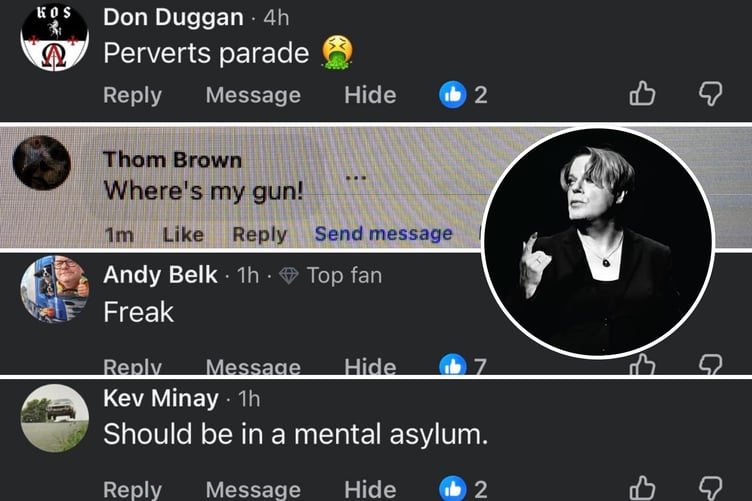
'Where's my gun?'
There was a grim and uncomfortable irony to it.
The online article, published on Isle of Man Today, was about the launch of a Pride night at Mad Jack's, an event designed to be an inclusive evening for members of the LGBTQ+ community and anyone else who wished to attend. It followed the cancellation of Onchan Pride and explored why creating safe spaces still matter to many people on the island.
As part of the story, we spoke to local drag performer Ashton Gibson, better known as Nona Binary, who talked about the hostility queer people can sometimes face online.
Within minutes of publication, the comments beneath the article had become a live demonstration of exactly what they were describing.
Some readers disagreed with the subject matter, and that's perfectly fine. Not everyone shares the same views about Pride events or drag performers. Healthy debate is part of living in a democratic society.
Others, however, jumped straight past the debate line and veered into outright abuse.
'Weirdo.'
'You're a mess.'


.jpeg?width=209&height=140&crop=209:145,smart&quality=75)

'Should invite all the doctors and psychiatrists.'
'Perverts Parade.'
Let's be very clear. Suggesting LGBTQ+ people are mentally ill or sexual predators is not reasoned debate. It is personal abuse aimed at people because of who they are.
What's even more disheartening is that the subsequent pile-on meant we eventually had to disable commenting altogether.
Shortly afterwards, one island resident contacted us after reading what had been posted.
Because of the nature of the subject, he asked to remain anonymous and, given some of the comments I've already listed, who can blame him?
'I tend to avoid comment sections in general,' he told me. 'But I know a lot of young queer people on the island and I feel like I need to stick up for them. A year or so ago there was a Pride post and the comments were vile. I reported some because they were threatening.'
But herein lies part of the problem. Reporting doesn't always make the situation go away.
Earlier this year, Meta announced a significant change to the way it moderates content across Facebook and Instagram, saying it wanted to prioritise 'more speech and fewer mistakes'.
The company said it would focus more heavily on illegal or high-severity content while taking a lighter-touch approach to moderating other posts.
Critics warned the changes could leave more abusive or hateful comments visible, particularly those directed at minority groups, while supporters argued they represented an important step towards protecting free expression.
Whether those changes are connected to what we're seeing here is impossible to say, but the increasingly hostile tone that often accompanies discussions involving LGBTQ+ people online has become difficult to ignore.
As for our own website and social media channels, we do our best to moderate comments, removing those that cross the line.
But there simply aren't enough hours in the day to catch everything immediately.
It's not just online however, our anonymous correspondent says.
'I think hate in general is getting worse and I worry about where it's going,' he added.
He is openly gay and said that while most hostility now happens online, it has also spilled into everyday life.
The most recent incident he recalled involved a man making exaggerated vomiting noises at him and his partner simply because they were holding hands during a night out.
That happened here, on the Isle of Man.
It would be comforting to dismiss incidents like these as isolated examples, but only days later another article produced remarkably similar responses.
The Isle of Man Arts Council announced that Suzy Eddie Izzard would deliver its annual lecture later this year.
Again, the comments quickly filled with insults.
'The freak is as funny as contracting gonorrhoea.'
'Freak.'
'Should be in a mental asylum.'
You do not have to enjoy someone's comedy. You do not have to agree with their views or even buy a ticket.
But reducing another human being to insults about their identity serves no purpose other than to demean.
The Examiner asked the Isle of Man Constabulary about online hate.
Police said reports are assessed on a case-by-case basis and encouraged people to report comments that are threatening, incite violence or cause significant alarm or distress.
Where comments meet the threshold for criminal offences, including harassment or communications offences, they may be investigated and referred for prosecution.
That distinction matters.
Not every unpleasant comment is a criminal offence - and nor should it be.
Freedom of expression is one of the foundations of a healthy society, and people should be free to express opinions that others disagree with.
But freedom of expression has never meant freedom from responsibility.
Some people seem to believe that because they are sitting behind a keyboard, ordinary standards of politeness and decency no longer apply.
Somehow, comments that would never be made face to face become acceptable once typed on a screen.
In my view, one of the most striking aspects of the comments beneath these stories wasn't simply what was being said.
It was how comfortable people appeared to be attaching their own names to those comments.
The idea of a digital footprint is not a new concept by now - every comment, every post, every reaction becomes part of a record that can be searched, shared and remembered long after the moment has passed.
Yet many people appear to give little thought to the impression they leave behind.
Before posting a comment online, perhaps there is one simple question worth asking.
Would I say this to someone's face?
If the answer is no, perhaps it shouldn't be posted at all.
Disagreement can contribute to debate. Challenging ideas is healthy. Holding different opinions is inevitable.
But calling strangers 'freaks', questioning their mental health or posting comments like 'Where's my gun?' contributes nothing.
The response to my article proved one thing beyond any doubt.
The conversation about online hate speech is not over.
In fact, judging by the reaction, it may be more necessary now than ever.
I’ve always felt that the Isle of Man prides itself on being a close-knit community. We celebrate the way neighbours help one another, how charities are supported and how people rally together when someone is in need.
I’d hate to see that sense of community disappear the moment we logged on.
The question is not whether people have the right to express themselves online.
The question is why so many choose to use that right to demean others.