.JPG?width=94&height=94&crop=1:1,smart&quality=75)

In the second of a two-part account, Isle of Man Today deputy editor Andy Dalrymple from Douglas outlines the treatment journey his son Hector has faced since his brain tumour diagnosis in November 2024, including surgery and specialist care in the UK. You can read the first part of the feature here.
Throughout Hector’s illness, one of the biggest emotions I’ve felt is that of uselessness.
With my neurology skills sadly lacking, there was little I could do to make him better other than distract and reassure him - and even that felt impossible at times.
Alder Hey in Liverpool, though, isn’t among the world’s best children’s hospitals for nothing. The specialist IV team tried to engage him before unleashing their secret weapon: a guitarist named Matthew and a clarinet player named Rachel. Yes, you read that right.



The night before we’d unsuccessfully tried to distract Hector with a ‘Where’s Wally?’ book while his bloods were taken, but now he had two talented musicians serenading him in an attempt to take his mind off the moment.
I’m not saying it lessened his pain, but it certainly made the process easier and briefly provided one of those moments of calm I mentioned earlier.
They clocked Hector’s dinosaur T-shirt and played the Jurassic Park theme tune, then later unintentionally sparked one of many bouts of tears when they segued into one of my favourite songs, ‘Africa’ by Toto.
The ‘set’ ended with some of Hector’s favourites: Firework by Katy Perry and Jolene by Dolly Parton (we have eclectic tastes in our house).
Later that afternoon Hector went for his MRI, walking down despite admitting he didn’t want to do it. The emotional bus route this whole process takes you on moves at a pace far quicker than the number 5 from Douglas to Peel.
There are stops at ‘overwhelmed’, ‘helplessness’ and ‘fear’, but in quick succession you also find yourself at ‘pride’, ‘admiration’ and ‘love’.
The pride I felt in my little boy that day was immeasurable.
The next day, the doctor talked us through the results of the previous day’s tests.
His bloods had shown nothing abnormal, but his MRI confirmed the presence of a walnut-sized growth in Hector’s brain, in a cavity which is usually vacant.
Further tests at the eye clinic showed a build-up of pressure that, if left unchecked, could eventually impair his sight.
He aced the more traditional form of the eye test, recognising even the smallest shapes that I was struggling to make out event when stood considerably closer to them.
This information was to be used to form a treatment plan.
It was expected this would kick into action at the start of the following week, but his surgical team decided called an ‘audible’ in American football terms after seeing the results of Hector’s eye tests.
They made the decision to try and alleviate some of this pressure while also deflating his cyst/tumour, collecting a sample of it and the fluid that surrounded it.
The latter could then be sent for further tests to determine its makeup and whether Hector would require further surgery or another form of treatment.
This decision was made on Friday teatime to operate on Saturday morning meaning thankfully we didn’t have too much time to dwell on it.
The surgeons explained it was a straightforward and relatively minor procedure, but to me it was still brain surgery and once again you begin wargaming worst-case scenarios in your head, while outwardly attempting to remain calm and non-emotional for Hector.
He was again a star the next morning.
I’d explained to him they needed to make a small hole in his head and he seemed relatively unphased by this.
He was probably too young to comprehend what was going on but again trotted down to the theatre holding our hands like we were dropping him off for school.
The next couple of hours dragged to say the least. Usually there is not enough time in the day for us to fit in our work, the kids’ clubs, jobs around the house, sport etc, but the next few hours felt like days.
You always ask the doctor how long an operation or procedure will take, but that information is a dangerous thing.
If it doesn’t finish exactly when you were expecting, whether early or late, you begin questioning the reasons why.
Hector’s finished earlier than planned. I panicked thinking there’d been some reason they had had to cut it short, but like an exam or car journey that goes well, it had concluded quicker than expected.
He had finished off two bourbon biscuits by the time he arrived back on the high-dependency section of the ward, and a burger and chips later he was soon back in his old room with seemingly little ill-effects aside for clump missing from his hair and some stitches that marked the point of entry.
I couldn’t get over the speed of his recovery from the procedure. It was soon confirmed that Hector had a craniopharyngioma, a rare, slow-growing, benign brain tumour near the pituitary gland.
There are approximately 30 new cases diagnosed in children between the age of five and 14 in the UK each year.
The cause is not fully known, but it stems from abnormal growth of embryonic cells meaning Hector likely had it before he was even born.
The initial surgery to drain the tumour had gone well and they’d left a reservoir, or ‘magic button’ as Hector likes to call it, that sits just under the skin of his head in case they quickly need to drain it again to relieve any pressure build up.
This meant we got the fantastic news that we could return home for Christmas.
We were elated to be given the chance to spend a family Christmas together in the Isle of Man, but one look round the neurology ward you were acutely aware that that wasn’t going to be the case for every child in there. Your joy is tempered by guilt that you get to go home.
The surgery hadn’t removed the tumour, and Hector would require a further six-week block of proton therapy treatment at the Christie Hospital in Manchester so after a brief pause of the emotional rollercoaster, 2025 would bring its own challenges.
I remember our new year’s celebrations being quite subdued. It was almost like we didn’t want the calendar to change as we knew once it did, we would have to come out of our temporary bubble of normalness and navigate our next challenge.
After a couple of months, it was confirmed Hector would start his treatment in March. This meant a myriad of plans had to be made as to how we were going to split our time between here and Manchester and how that effected all five us as a family unit.
That included what to do with Hector’s four-year-old sister Dottie. Bek, who would be in Manchester with Hector for the whole six weeks, decided she wanted to bring her with them despite the challenges of having two under-sixes in toe.
It proved a wise decision as Dottie became Hector’s number one hype woman often providing a welcome distraction and pick-me-up not only for Hector, but for the rest of the family as we tried to navigate our way through six long weeks away from home.
Prior to heading to Manchester, Hector had to have two trips to the UK, one to have a central line fitted so they could easily draw bloods and administer the 28 general anaesthetics he would have over the course of the treatment.
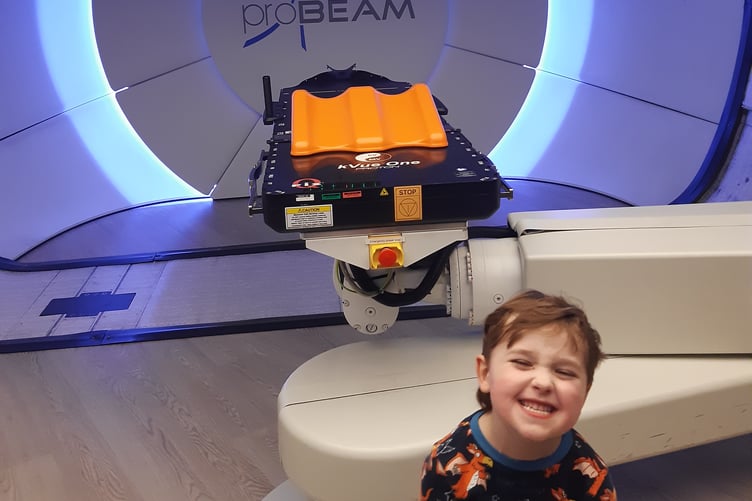
There was also a planning trip to the Christie where he would have his special mask made which makes sure the proton therapy was as accurate as possible and didn’t affect other parts of his brain.
Proton therapy is a precise type of radiation treatment which significantly reduces damage to nearby critical organs. It was warned though prior to starting the treatment, that there was a chance there could be side-effects including reduced cognitive function among other things.
Thankfully the relatively small size of Hector’s tumour, meant that he hasn’t as yet had any major side-effects and he even managed to avoid the worse of the nausea and tiredness that patients can suffer because of the treatment.
Nevertheless, the six weeks at the Christie was another series of up and downs as Hector had to deal with daily ‘nil-by-mouth’ periods and the emotions of being away from his family.
In total Hector had 28 bouts of treatment over the course of the six weeks. That meant 28 general anaesthetics, a process he got so used to that quite quickly he was pressing the button that would administer the anaesthetic himself under the watchful eye of the ever-obliging anaesthetists. It was strange how normal that became. Visiting members of family were often picked out by Hector to accompany him down so he could so he could show them his new ‘party trick’. In a way that sums up this whole process - the surreal becoming the norm.
The staff at the Christie, like their colleagues at Alder Hey, were nothing short of fantastic with Hector during his six weeks as an outpatient under their care. The small team of nurses, radiotherapists, consultants and play therapists could not do enough for Hector or the rest of us. Quite simply, it made a tough period away from home manageable for us all.
The atmosphere in the Proton Centre is inspiring and it lives up to the motto emblazoned on one of its walls: ‘Think like a proton – stay positive.’
Since his return from Manchester in May, Hector has been back at school and things are slowly returning to the norm of before.
He has been back to Alder Hey for a couple MRIs to monitor the tumour and how it’s reacted to the treatment.
Thankfully it continues to shrink, and he has shown none of the symptoms there were prior to his initial diagnosis. All is very promising.
Hector’s brain tumour journey is far from over though. Since returning he has started play therapy at Noble’s Hospital.
Primarily this is because they want to get to a point where he can have his MRIs without a general anaesthetic, but also because since this all started Hector has developed a real fear of medical procedures, even things as simple as having a plaster removed.
The sessions he attends are really beginning to help with the latter and hopefully this progress will continue.
I think we are all just realising now the mental toll it has taken on all of us and writing this piece has certainly helped me ‘sort my thoughts’.
Bek, who has been as much of a superstar as Hector throughout this, reflecting on the year recently described it as a year of contradictions. She said: ‘I’ve felt every emotion you can imagine and at times I’ve felt numb.
‘I’ve jumped from devastated to grateful, often in the same conversation.
‘I’ve felt so much appreciation for the everyday and so much guilt for those who don’t get to return to it.
‘I’ve felt so lucky Hector has a long future ahead of him, but have also wanted to hit pause to prevent any more challenges coming his way.’
The next of these is likely to be around his hormones which can affect his growth and weight.
This was flagged up as a likely issue at the onset of his diagnosis because of the tumour being near to his pituitary gland.
.jpeg?width=752&height=500&crop=752:500)
We’re awaiting blood tests and the opinion of the endocrinologists at Alder Hey as to whether Hector will need ongoing hormone treatment. In fact he was due there for an appointment this week to update on hormone replacement treatment.
That will of course come with its own challenges.
Those of you who have persisted with my ramblings will remember at the start of part one, I said one of the main motivations of writing this was to hopefully show parents of children with serious illness that what can seem like a very lonely path has been trodden before.
We remain on this ‘path’ but thanks to the support of the medical professionals mentioned, family, friends, colleagues and even those of you taking the time to read this, it isn’t the lonely one it seemed 18 months ago.
If you would like to donate to Bek’s marathon effort in aid of the Christie, visit: https://www.justgiving.com/page/team-hector